Well Water Testing in Monroe County: Where, What and How Often
A free resource for Monroe County private well owners. Last checked: October 2026.
Call (317) 798-0634Get a Free Well Quote
If your home outside Bloomington's city water lines runs on a private well, nobody tests that water for you. That's the owner's job. The good news is that testing is cheap and local. This guide covers where to take a sample, what to test for and how often, and how to find your well's original drilling record.
What to test for, and how often
The Indiana Department of Health (IDOH) Laboratory's well water page recommends the following for all private wells:
| How often | Test for |
|---|---|
| Every year | Bacteria and nitrate |
| At least every 5 years, or whenever major maintenance is done | Fluoride, arsenic, lead and copper |
If any result comes back elevated, IDOH recommends additional testing.
Other good times to test:
- After flooding near the wellhead
- After any repair, pump replacement or other work on the well (IDOH specifically mentions major maintenance)
- If the water's taste, smell or color changes
- When you buy a home with a well
- If someone in the home is pregnant or there's an infant (nitrate is a common concern; ask your doctor or the health department)
Option 1: Bacteria testing in Bloomington (Dillman Road lab)
The Monroe County Health Department says drinking water coliform testing is done by the City of Bloomington's Dillman Water Treatment Lab:
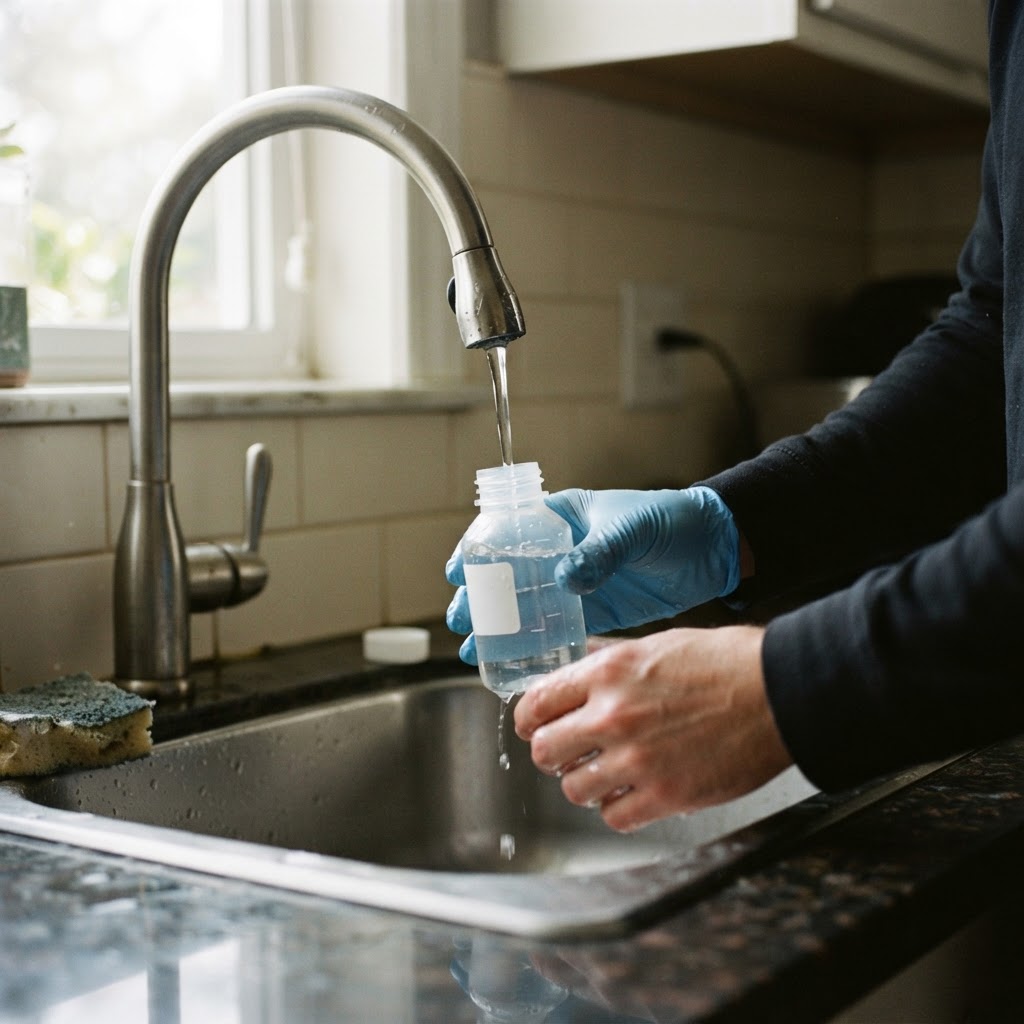
The county says the lab's public services include bacteria tests on private well water (and swimming pools). You can bring samples in or pick up empty sample bottles during the lab's posted drop-off hours. Call ahead to confirm hours and fees, and use the county's Water Testing Form (linked on the county page).
Tips for a valid bacteria sample:
- Use only the lab's sterile bottle, and don't rinse it.
- Sample from a cold-water tap without an aerator or filter if possible. Run the water for a few minutes first.
- Keep the sample cold and deliver it as soon as possible. Bacteria samples are time-sensitive, so ask the lab about its limit.
Option 2: The state lab (IDOH) by mail
The IDOH Laboratory in Indianapolis tests private drinking-water wells. Its listed prices for private citizens are:
- Bacteria: $10
- Nitrate: $10
- Fluoride: $10
- Arsenic, lead and copper: $20
Prices don't include shipping. Order sample containers through the Access Indiana link on the IDOH well water page. Kits are mailed after you order. Samples ship to IDOH Laboratory, Suite B, 550 W. 16th St., Indianapolis, IN 46202, with the chain-of-custody form included. Questions: IDOHChemistryLab@health.in.gov.
The state lab is the simple way to get the 5-year panel (fluoride, arsenic, lead and copper) alongside the yearly bacteria and nitrate tests.
Other Monroe County resources
The county water testing page also lists:
- Well disinfection directions, plus flood-emergency guidance for disinfecting wells and treating small amounts of drinking water
- A free PFAS test study: researchers from Indiana University and RTI International are recruiting Monroe County private well owners for a grant-funded study with free mail-out PFAS test kits. Details are at cleanwaterforuskids.org/foreverchemicals or 855-997-3184.
- Free well assessments: the Rural Community Assistance Partnership (RCAP) is looking for well owners for an in-person assessment of site conditions, geology, construction and maintenance. It doesn't include sampling. To nominate your well, email Steve Wilson at sdwilson@illinois.edu.
- Questions: Monroe County Health Department wastewater specialists, wastewater@co.monroe.in.us or 812-349-2543 (option 3). The county says walk-in hours are normally 8 to 9 a.m. on weekdays and recommends making an appointment.
How to look up your well log
Your well log (drilling record) tells you things like how deep the well is and how it was built, which is useful when you're interpreting test results or replacing a pump.
The Indiana DNR's Water Well Record Database holds records for more than 400,000 wells drilled in Indiana, about 138,000 of them field verified. Here's how to use it:
- Open the Water Well Records Viewer from the DNR page. It supports street address and zip code searches.
- You can't search by owner name, so use the map or your address.
- Read the DNR's "About This Service" and "Database Search Help" pages first if it's your first time.
- Older homes may have no record, or one under a previous address. A well driller or the county can sometimes help match it up.
Reading your results
- Bacteria present: don't drink the water until the problem is fixed. Follow the county's disinfection directions, then retest. If bacteria keep coming back, have the well cap, casing and seal inspected.
- Elevated nitrate: IDOH recommends additional testing. Nitrate often points to nearby surface sources, so check the area around the wellhead.
- Metals (arsenic, lead, copper) elevated: retest and ask the health department about treatment options. Lead and copper can come from plumbing, not just the aquifer.
Related pages on this site
FAQ
Need help with the well itself?
Bloomington Well Drilling is a local referral service. We pass your request to an independent local well contractor, who contacts you directly about inspection, pump or well work. Call (317) 798-0634 or use the quote form.
Last checked: October 2026. Details come from IDOH, the Monroe County Health Department and the Indiana DNR. Confirm hours and prices before you go.